


Why Image Annotation Has Become a Strategic Priority
The race to deploy safe, scalable autonomous vehicles depends on one foundational capability that rarely gets boardroom attention: image annotation for autonomous vehicles. Without precisely labeled training data, even the most sophisticated AI perception models fail. A misidentified pedestrian, a missed stop sign, or a misclassified lane marking at 65 mph is not a model error. It is a data quality failure.
According to McKinsey & Company, autonomous vehicle programs that invest in structured data pipelines reduce model retraining cycles by up to 40%. Yet most automotive organizations still treat annotation as a back-office task rather than a strategic engineering discipline. That gap is closing fast, and the companies that close it first will define the next decade of mobility.
This guide is written for technical and executive leaders, including CTOs, CIOs, and CXOs, who are responsible for AI infrastructure decisions in the automotive sector. It explains where image annotation stands today, where it is heading, and what your organization needs to do to stay competitive.
What Is Image Annotation for Autonomous Vehicles?
Image annotation for autonomous vehicles is the process of labeling visual data, including camera frames, LiDAR point clouds, and radar outputs, so that machine learning models can learn to identify and classify objects such as vehicles, pedestrians, road signs, lane markings, and obstacles in real-world driving environments.
Annotation serves as the ground truth layer that teaches perception AI what the world looks like. Without it, self-driving systems cannot distinguish a cyclist from a traffic cone, or a wet road surface from a dry one.
The State of Automotive Image Annotation in 2025
The autonomous vehicle sector has matured significantly. First-generation annotation workflows relied on manual bounding boxes drawn by offshore teams working with basic polygon tools. That model no longer meets the performance requirements of modern AV stacks.
Today, the annotation landscape in the automotive industry is shaped by three converging forces:
- Model complexity — Transformer-based perception architectures require richer, multi-modal annotations, not just 2D bounding boxes.
- Data volume — A single AV test vehicle generates between 1 and 4 terabytes of sensor data per day, according to Intel. Scaling annotation to match that volume is a logistical and technological challenge.
- Regulatory pressure — The NHTSA’s Automated Vehicles for Safety framework and emerging ISO 21448 (SOTIF) standards require traceability in training data, which demands annotation audit trails.
The implication for leadership teams is direct: annotation is no longer a commodity task you can hand off without governance. It is a core AI infrastructure function.
Beyond Bounding Boxes: The Annotation Techniques That Actually Matter
1. Semantic Segmentation
Semantic segmentation assigns a class label to every pixel in an image. For autonomous vehicles, this means the model learns not just that a car exists in a frame, but exactly which pixels belong to that car, that pedestrian, or that drivable road surface.
This matters because edge cases like a cyclist riding next to a parked delivery vehicle require pixel-level precision, not approximate bounding boxes. According to research published in IEEE Transactions on Intelligent Transportation Systems, semantic segmentation models trained on high-quality annotated datasets achieve up to 15% better intersection-over-union (IoU) scores compared to those trained on bounding box data alone.
2. Instance Segmentation
Where semantic segmentation labels all cars as one class, instance segmentation distinguishes Car A from Car B from Car C individually. This is critical for multi-object tracking in dense urban environments where vehicles and pedestrians cluster closely.
For executive decision-makers, the practical implication is cost. Instance segmentation is approximately 3 to 5 times more expensive to produce than bounding box annotation. Knowing when that investment is justified, versus when bounding boxes are sufficient, is a key procurement decision.
3. 3D LiDAR Point Cloud Annotation
Cameras capture appearance. LiDAR captures geometry. Modern AV perception systems fuse both, which means annotation teams must label 3D point clouds, not just 2D images.
Point cloud annotation involves drawing 3D cuboids around objects and assigning class labels, velocity vectors, and orientation data. This is technically demanding work. Errors in 3D annotation propagate into downstream path planning and object velocity estimation modules, creating safety risks that are invisible in model evaluation metrics until real-world testing exposes them.
4. Sensor Fusion Annotation
Leading AV programs are moving toward fused annotation pipelines where camera frames, LiDAR point clouds, and radar returns are annotated together as a coherent scene rather than independently. This approach, sometimes called multi-modal annotation, is more expensive to produce but yields training data that more accurately reflects how the vehicle’s perception stack actually processes the world.
IMS Datawise’s annotation infrastructure supports multi-modal fusion workflows designed for the data throughput requirements of Tier 1 automotive suppliers and AV technology companies operating at scale in the US market.
5. Temporal and Video Annotation
Static frame annotation misses motion context. Annotating sequential video frames, including tracking object IDs across frames and labeling occlusion events, produces training data that teaches models how objects move, not just where they appear at a single moment. This is especially relevant for cut-in scenarios, pedestrian crossing prediction, and emergency vehicle detection.
The Hidden Cost of Low-Quality Annotation
A common mistake executive teams make is optimizing annotation cost per label rather than cost per quality label. These are not the same metric.
Consider this scenario: a team annotates 500,000 frames at $0.05 per label. Five months later, model performance plateaus. The root cause is annotation inconsistency, specifically, different annotators applying slightly different rules for what counts as a partially occluded vehicle. The team re-annotates 200,000 frames at $0.08 per label with tighter quality protocols. Total cost: higher than if the quality protocols had been in place from the start.
Industry practitioners estimate that poor annotation quality can increase total model development cost by 20% to 35% through increased retraining cycles and delayed deployment timelines.
Key cost drivers in AV annotation:
- Annotation type complexity (bounding box vs. point cloud vs. fusion)
- Inter-annotator agreement rate (target: above 95% IoU consistency)
- Edge case coverage (rare scenarios require intentional data curation)
- Quality assurance methodology (sampling-based vs. full-review pipelines)
- Tooling infrastructure (custom vs. off-the-shelf labeling platforms)
How to Build a High-Performance Annotation Pipeline: A Framework for Technical Leaders
Step 1: Define Your Annotation Taxonomy
Before any labeling begins, define a precise ontology. What object classes does your model need to detect? What are the rules for labeling truncated objects? How do you handle ambiguous weather conditions? Every undefined edge case in the taxonomy becomes an inconsistency in the training data.
Step 2: Select the Right Annotation Modalities
Match your annotation types to your model architecture. If your perception stack uses a camera-only approach, semantic segmentation and temporal annotation are your priorities. If you are running a LiDAR-camera fusion system, you need synchronized 3D point cloud annotation alongside 2D labeling.
Step 3: Implement a Multi-Layer Quality Assurance Process
Best-in-class annotation operations use a minimum of three QA layers: – Annotator-level review — self-check before submission – QA specialist review — independent label verification – Automated consistency checks — programmatic detection of out-of-bounds labels, missing classes, and formatting errors
Step 4: Establish Data Governance and Traceability
For teams operating under NHTSA AV guidance or preparing for ISO 26262 / SOTIF compliance, annotation audit trails are not optional. Every label should carry metadata including annotator ID, timestamp, tool version, and revision history.
Step 5: Measure and Iterate on Annotation Quality Metrics
The three metrics every technical leader should track are:
– Inter-annotator agreement (IAA): Measures consistency across annotators. Target above 0.85 Cohen’s Kappa for classification tasks.
– Label accuracy rate: Percentage of labels passing QA review without revision. Target above 95%.
– Defect escape rate: Percentage of annotation errors that reach model training. Target below 1%.
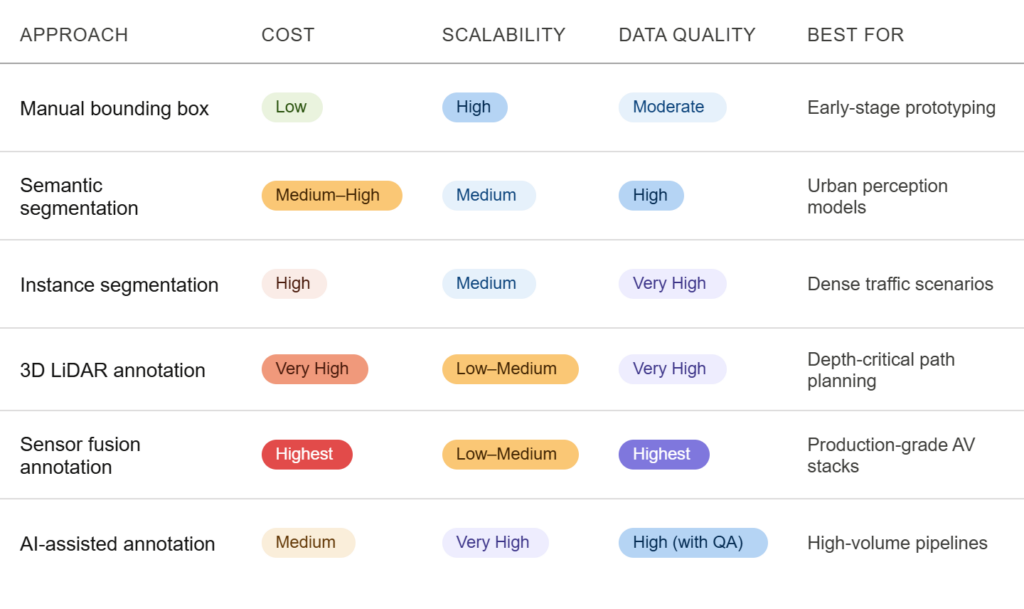
Comparison: Annotation Approaches for Autonomous Vehicle Programs
AI-Assisted Annotation: Accelerating Without Sacrificing Accuracy
The most significant operational shift in annotation over the past two years is the adoption of AI-assisted labeling. In this workflow, a pre-trained model generates initial annotations, and human annotators correct errors rather than labeling from scratch.
Research from MIT’s Computer Science and Artificial Intelligence Laboratory suggests that AI-assisted annotation can reduce annotation time by 50% to 70% on common object classes while maintaining accuracy parity with fully manual annotation, provided that the human review step is not compressed.
The critical caveat for executive teams: AI-assisted annotation degrades on rare and out-of-distribution scenarios, specifically the edge cases where annotation quality matters most. A robust pipeline uses AI assistance for common scenarios and routes edge cases to experienced human annotators.
What Sets IMS Datawise Apart in Automotive Annotation
IMS Datawise delivers annotation services built specifically for the throughput, accuracy, and compliance requirements of automotive AI programs operating in the US market. The team brings domain-specific expertise across camera, LiDAR, radar, and sensor fusion annotation with a QA infrastructure designed to meet the traceability requirements of ISO 26262 and SOTIF-aligned development programs.
For organizations scaling AV data pipelines from prototype to production, IMS Datawise offers the combination of technical depth and operational scale that generic annotation vendors cannot match.
What Sets IMS Datawise Apart in Automotive Annotation
IMS Datawise delivers annotation services built specifically for the throughput, accuracy, and compliance requirements of automotive AI programs operating in the US market. The team brings domain-specific expertise across camera, LiDAR, radar, and sensor fusion annotation with a QA infrastructure designed to meet the traceability requirements of ISO 26262 and SOTIF-aligned development programs.
For organizations scaling AV data pipelines from prototype to production, IMS Datawise offers the combination of technical depth and operational scale that generic annotation vendors cannot match.
Key Takeaways
- Image annotation for autonomous vehicles has evolved well beyond basic bounding boxes into a multi-modal, AI-assisted, compliance-aware engineering discipline.
- Semantic segmentation, instance segmentation, 3D LiDAR annotation, and sensor fusion labeling each serve distinct roles in the AV perception stack.
- Low annotation quality increases total model development cost by an estimated 20% to 35% through retraining cycles and delayed deployment.
- Regulatory frameworks including NHTSA AV guidance and ISO 21448 (SOTIF) are elevating annotation traceability from best practice to compliance requirement.
- AI-assisted annotation offers 50% to 70% time savings on common scenarios but requires human expert oversight for edge cases.
- The right annotation partner brings domain expertise, QA rigor, and the data governance infrastructure that production AV programs demand.
Strategic Conclusion
The autonomous vehicle industry is entering a phase where the differentiation between programs that succeed and those that stall will not come from model architecture choices alone. It will come from the quality, consistency, and governance of the data those models are trained on.
For CTOs, CIOs, and CXOs, this means treating image annotation for autonomous vehicles as a strategic infrastructure decision, not a procurement line item. The organizations that build or partner for annotation capabilities with genuine domain depth, rigorous quality systems, and compliance-aligned documentation will move faster, fail less often, and deploy safer systems.
IMS Datawise is built to be that partner for automotive AI programs that cannot afford to treat data quality as an afterthought.