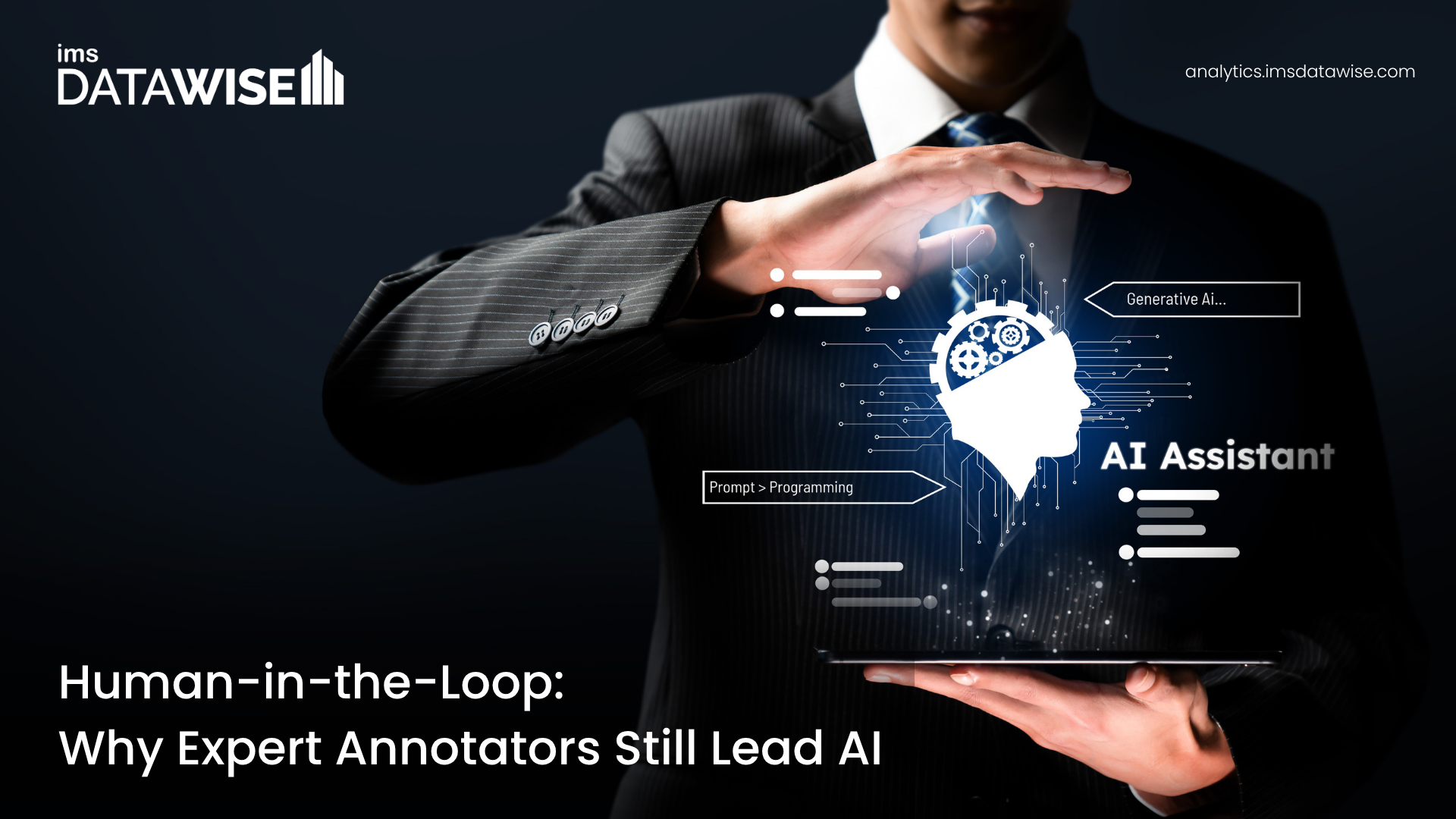

The AI Systems Your Business Depends On Are Only as Good as the Humans Behind Them
Artificial intelligence is reshaping how enterprises make decisions, automate workflows, and serve customers. But behind every reliable AI model, there is a layer that rarely makes headlines: human-in-the-loop (HITL) annotation.
As CTOs, CEOs, and technology leaders accelerate AI adoption, one question keeps surfacing in boardrooms and architecture reviews alike: Can AI really supervise itself?
The short answer is no. Not yet. And for mission-critical applications, perhaps not for a long time. According to a 2024 MIT Technology Review survey, over 64% of enterprise AI failures trace back to flawed, incomplete, or biased training data rather than model architecture. The models are not broken. The data pipelines are.
This is where expert human annotators remain irreplaceable. They are not a bottleneck. They are the quality gate that separates production-ready AI from costly enterprise risk.
What Is Human-in-the-Loop (HITL) in AI?
Definition (40-60 words): Human-in-the-loop (HITL) is an AI development framework in which human experts actively participate in the training, validation, and continuous improvement of machine learning models. Annotators review, label, and correct data to ensure the model learns from accurate, contextually grounded information rather than unchecked automated outputs.
Why Human Annotation Is Not a Relic of Early AI
A common misconception in enterprise technology circles is that large language models and foundation models have outgrown the need for human annotation. This belief is both premature and operationally dangerous.
The Limits of Self-Supervised Learning
Self-supervised learning has advanced dramatically. Models like GPT-4 and Gemini Ultra train on vast text corpora without human labeling at scale. Yet these models still require Reinforcement Learning from Human Feedback (RLHF), a process that is fundamentally built on expert human judgment.
According to Anthropic’s published model documentation, Claude’s alignment and safety properties rely heavily on iterative human feedback loops during fine-tuning. OpenAI’s technical reports for GPT-4 similarly acknowledge that human rater guidelines are central to reducing harmful outputs and improving response quality.
The pattern is clear: the more capable the model, the more nuanced and expert the human feedback needs to be.
Where Automation Breaks Down
AI models fail predictably in four areas where human annotation provides decisive value:
- Ambiguous context: Natural language is deeply contextual. Sarcasm, cultural references, domain jargon, and legal language require human judgment that keyword-matching algorithms cannot reliably replicate.
- Edge cases and anomalies: Production data contains rare events and outlier scenarios that fall outside model training distributions. Human annotators identify and properly label these to prevent silent failures.
- Ethical and compliance-sensitive content: In healthcare, finance, and legal sectors, a misclassification is not just a performance metric issue. It is a regulatory liability. Human review ensures that annotations meet domain-specific compliance standards.
- Multimodal ambiguity: As AI systems process images, audio, and video alongside text, interpretation across modalities requires human validators with domain expertise, not generalist automated pipelines.
The Expert Annotator Advantage: What Separates Specialists from General Labelers
Not all human annotation is equal. There is a meaningful difference between crowdsourced labeling and expert annotation, and enterprise AI teams that conflate the two pay for it in model retraining cycles, incident costs, and delayed deployments.
Expert Annotators Bring Domain Authority
An expert annotator in medical imaging is not simply clicking “tumor” or “no tumor.” They are applying years of clinical training to distinguish benign tissue variations from malignancy under annotation guidelines developed with oncologists. The same principle applies to legal document review, financial sentiment analysis, and autonomous vehicle perception tasks.
At IMS Datawise, expert annotation teams are structured by vertical. A financial services annotation project is staffed with annotators who hold relevant domain credentials, not general-purpose labelers retrained overnight. This approach reduces inter-annotator disagreement rates and improves the signal quality of every labeled dataset.
Quality Metrics That Matter to CXOs
When evaluating annotation quality, technology executives should track:
- Inter-Annotator Agreement (IAA): Cohen’s Kappa or Fleiss’ Kappa scores above 0.80 indicate high labeling consistency
- Label Error Rate (LER): Industry benchmarks from MIT CSAIL research suggest that up to 3.4% of labels in widely used benchmark datasets contain errors, which compounds significantly at enterprise scale
- Annotation Throughput vs. Accuracy Tradeoff: Speed incentives in low-cost labeling pipelines systematically reduce accuracy; expert annotators optimize for precision over volume
Human-in-the-Loop vs. Fully Automated Labeling: A Comparison
| Dimension | Expert HITL Annotation | Fully Automated Labeling |
|---|---|---|
| Accuracy on edge cases | High | Low to moderate |
| Domain-specific nuance | Strong | Weak without fine-tuning |
| Regulatory compliance fit | Built-in | Requires additional review |
| Cost per label | Higher upfront | Lower upfront, higher rework |
| Model retraining frequency | Reduced | Increased |
| Risk in production | Lower | Higher |
| Scalability | Structured scaling | Rapid but quality-variable |
| Best suited for | Healthcare, legal, finance, safety-critical AI | Simple classification, high-volume commodity tasks |
Strategic insight for CIOs: Total cost of ownership for automated labeling pipelines frequently exceeds HITL annotation when downstream model failures, retraining cycles, and incident remediation costs are factored in. A 2023 Gartner report on AI data quality estimated that poor data quality costs organizations an average of $12.9 million annually.
How HITL Annotation Works in an Enterprise AI Pipeline
Understanding the operational mechanics helps technology leaders design annotation workflows that scale without sacrificing quality.
Step-by-Step: Expert Annotation in a Production AI Pipeline
- Data ingestion and sampling: Raw enterprise data is collected, anonymized where required, and sampled for annotation batches.
- Annotation guideline development: Domain experts and ML engineers co-author detailed labeling guidelines covering edge cases, boundary conditions, and ambiguity resolution rules.
- Annotator qualification and calibration: Expert annotators are tested on gold-standard datasets to establish baseline accuracy before joining active projects.
- Multi-pass annotation: Complex or high-stakes labels receive independent annotation from two or more experts, with disagreements adjudicated by a senior reviewer.
- Quality audit and spot-checking: A defined percentage of all labels undergoes independent audit. Failure rates above threshold trigger batch review.
- Model feedback integration: Validated annotations enter the training pipeline. Model outputs on held-out sets are reviewed by annotators to close the feedback loop.
- Continuous monitoring post-deployment: As production data drifts from training distributions, annotators label new examples to support model refresh cycles.
Real-World Applications: Where HITL Annotation Delivers Measurable ROI
Healthcare AI
Clinical NLP systems that extract diagnoses, medications, and procedures from unstructured physician notes require medical coding experts as annotators. Errors in this domain directly affect insurance claims processing and patient safety. HITL annotation in healthcare AI has been shown to reduce coding error rates by 30 to 40% compared to fully automated extraction, according to research published in the Journal of the American Medical Informatics Association (JAMIA).
Financial Services
Sentiment analysis models used in trading and risk systems must distinguish regulatory language from market commentary with precision. Expert annotators with compliance backgrounds ensure that training data reflects the actual semantic distinctions that matter in regulated contexts.
Legal Technology
Contract review AI systems require annotators who understand legal concepts such as indemnification, force majeure, and governing law clauses. Without expert annotation, these models produce high rates of false positives that erode attorney trust in the tool.
Autonomous Systems and Robotics
Perception models for autonomous vehicles require annotators who can accurately label object boundaries, occlusion states, and road conditions across millions of image frames. Expert annotators in this domain reduce label ambiguity in critical safety scenarios that automated labeling tools consistently misclassify.
The EEAT Dimension: Why Annotation Quality Is Now a Google Ranking Signal (By Analogy)
Google’s Helpful Content system and EEAT framework reward content that demonstrates real human expertise and firsthand experience. The same logic applies to AI systems at an operational level.
An AI model trained on expert-annotated data demonstrates measurable competence in the tasks it is designed for. It answers domain questions accurately. It handles edge cases gracefully. It earns user trust through consistent performance. These are not abstract values. They translate directly to adoption rates, user retention, and enterprise contract renewals.
Technology leaders who invest in HITL annotation infrastructure are not just improving model metrics. They are building AI systems that users trust, which is the most durable competitive advantage in the current market.
Pros and Cons of Human-in-the-Loop Annotation
Pros
- Delivers higher accuracy on ambiguous, complex, and domain-specific tasks
- Reduces regulatory and compliance risk in sensitive verticals
- Creates auditable, explainable training data lineage
- Enables models to handle edge cases that automated pipelines miss
- Supports bias detection and mitigation at the data layer
Cons
- Higher cost per label compared to automated approaches at identical volume
- Requires structured workforce management and annotator quality programs
- Introduces potential for annotator fatigue on high-volume projects if not managed with proper rotations and calibration protocols
- Scaling requires investment in annotator recruitment, training, and retention
FAQ: Human-in-the-Loop AI Annotation
What is human-in-the-loop annotation in AI?
Human-in-the-loop annotation is a process in which qualified human experts review, label, and validate data used to train and improve AI models. Rather than relying solely on automated labeling, HITL incorporates human judgment at critical stages to ensure accuracy, reduce bias, and meet domain-specific quality standards.
Why do AI models still need human annotators in 2025?
Despite advances in self-supervised and semi-supervised learning, AI models continue to require human annotation for complex, ambiguous, or high-stakes tasks. Edge cases, domain-specific nuance, ethical judgment calls, and compliance requirements exceed the reliable capability of automated labeling systems in sectors such as healthcare, legal, and financial services.
How does human annotation improve AI model accuracy?
Expert annotators improve model accuracy by providing consistent, high-quality labels that reduce training noise, by flagging and correctly labeling edge cases that automated systems misclassify, and by participating in feedback loops that catch model errors before they propagate into production. Inter-annotator agreement scores and label error rates are the primary quality metrics.
What should CTOs look for in an AI annotation partner?
CTOs evaluating annotation partners should assess domain expertise depth by vertical, annotator qualification and calibration processes, quality audit frameworks and reported IAA scores, data security and compliance certifications, and the provider’s ability to scale annotation teams without degrading quality thresholds.
Key Takeaways
- Human-in-the-loop annotation is not optional for enterprise AI. It is the mechanism that converts raw data into trustworthy model intelligence.
- Expert annotators outperform general-purpose labelers on domain-specific, ambiguous, and compliance-sensitive tasks where model accuracy directly affects business outcomes.
- The total cost of ownership for annotation favors HITL approaches when downstream model failure costs, retraining cycles, and regulatory risk are included in the calculation.
- Quality metrics including inter-annotator agreement scores, label error rates, and audit pass rates are the KPIs that technology leaders should require from any annotation partner.
- As AI models grow more capable, the complexity and expertise requirement for human feedback loops increases rather than decreases.
Strategic Conclusion
The narrative that AI will eventually annotate itself into perfection is appealing, but operationally premature. The models that enterprise organizations are betting their competitive advantage on today are precisely the models that require the most sophisticated human oversight, not the least.
For CTOs and CIOs building AI infrastructure at scale, the annotation layer is not a cost to minimize. It is a strategic investment in model reliability, regulatory defensibility, and user trust. The enterprises that recognize this early will deploy AI that performs consistently in production. Those that treat annotation as a commodity will face the compounding costs of model degradation, data rework, and eroded stakeholder confidence.
IMS Datawise delivers expert annotation programs built for the precision demands of enterprise AI. From healthcare NLP to financial document classification and autonomous systems perception, every annotation engagement is staffed, audited, and optimized to deliver the data quality your models require to perform in the real world.