

In 2026, insurance companies will face unprecedented pressure to optimize operations, meet stricter regulations, and deliver superior customer experiences. This is where Insurance Process Outsourcing (IPO) becomes more than a cost-cutting tactic; it becomes a profitability engine.
From insurance business process outsourcing (BPO) services to advanced business process management outsourcing – insurers are increasingly shifting routine, labour-intensive tasks to specialized partners. Success in outsourcing isn’t a given; it hinges on tracking the KPIs that truly reflect efficiency, regulatory compliance, and customer satisfaction.
This makes it necessary for insurers to understand the current operational landscape and benchmark performance effectively.
Current Industry Scenario of Insurance Operation
Country / Segment | Expense Ratio | Operating Margin | Net Profit | Policy Retention | |
US – P&C | $1.05T (direct premiums) | 31% (operating expenses) | 3–4% (underwriting margin) | $85B (net income) | ~88% (personal/commercial lines) |
US – Life & Annuities | $1.4T (premiums + deposits) | Varies by product | Thin (investment-driven) | Directional indicator | ~63% (life persistency) |
UK – Non-Life / General | £55.5B (gross written premiums) | 44–45% (combined expense) | ~4% (operating margin) | £1.77B (major insurers | High (varies by line) |
UK – Life & Long-Term Savings | Large, split by product | Varies by product type | Investment-driven margin | £1.77B (Aviva) | Varies by product |
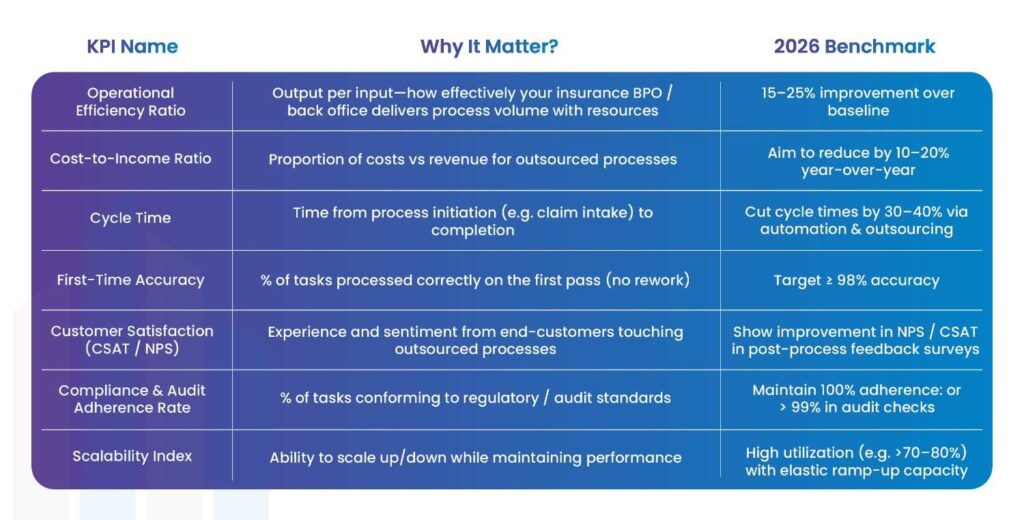
With 63% of insurers set to increase outsourcing by 2026, are you tracking the seven essential KPIs that set the benchmark for insurance outsourcing services?
7 metrics that will define outsourcing insurance services in 2026
1. Operational Efficiency Ratio
Outsourcing, at its core, should enhance operational efficiency. This KPI measures the value delivered per unit of input; essentially how effectively your insurance BPO services are running processes.
Why it matters?
- A high efficiency ratio indicates optimized workflows, effective automation, and better resource utilization.
- It demonstrates whether outsourcing partners are truly reducing overheads in the insurance back-office.
Upcoming shift in 2026:
With AI-powered automation embedded in insurance business process management outsourcing, insurers can expect measurable efficiency gains of 10% to 15% across claims, renewals, and policy issuance.
2. Cost-to-Income Ratio
The KPI tracks the proportion of operational costs compared to income generated, directly tying outsourcing performance to profitability.
Why it matters?
- Lowering this ratio reflects reduced costs through insurance BPO while sustaining or growing revenue.
- It validates outsourcing as a profitability enabler, not just an expense reduction.
Upcoming shift in 2026:
With compliance costs and inflation impacting margins, insurers must select insurance business process outsourcing partners that deliver scalability without eroding profitability.
3. Cycle Time
In insurance, speed drives success, and Cycle Time is the metric tracking how efficiently tasks from claims to policy issuance are processed.
Why it matters?
- Faster cycle times improve customer satisfaction and retention.
- Efficient insurance back-office operations enable insurers to process more with less.
Upcoming shift in 2026:
Outsourcing providers leveraging digital intake, AI-driven triage, and business process management outsourcing tools can reduce cycle times by up to 50%, setting a new industry standard.
4. First-Time Accuracy (FTA) / Error Rate
Errors are costly and can harm customer’s trust, which is why First-Time Accuracy (FTA) tracks the percentage of processes completed correctly the first time, without rework.
Why it matters?
- High accuracy reduces costs and accelerates throughput.
- Consistently strong FTA is a hallmark of a reliable insurance BPO service provider.
Upcoming shift in 2026:
Industry reports and case studies indicate that leading insurance outsourcing service providers are already achieving claims processing accuracy rates exceeding 98% in outsourced operations, making it a reasonable expectation in 2026.
5. Customer Satisfaction (CSAT / NPS)
At the end of the day, customer experience drives profits and even though outsourcing handles the operations, it’s your policyholders who feel the impact.
Why it matters?
- Smooth, error-free service increases loyalty and lifetime value.
- Insurance business process management outsourcing must align with customer-centric outcomes.
Upcoming shift in 2026:
Insurers will increasingly link outsourcing contracts to CSAT or NPS scores, ensuring partners deliver measurable improvements in customer experience.
6. Compliance & Audit Adherence Rate
Regulatory compliance is non-negotiable in insurance, and this key KPI measures how consistently outsourced processes adhere to regulations and audit standards.
Why it matters?
- Non-compliance leads to fines, reputational harm, and customer distrust.
- Outsourcing providers with deep regulatory knowledge reduce this risk significantly.
Upcoming shift in 2026:
Expect to see compliance dashboards and real-time reporting built into business process management outsourcing platforms, giving insurers instant visibility into adherence.
Additionally, insurers will lean on personalized digital tools that adapt compliance workflows, read more on tackling these challenges here.
7. Scalability Index
Insurance demand fluctuates like claims surge during disasters – underwriting spikes during new product launches. Scalability measures how well outsourcing absorbs these changes without excessive cost.
Why it matters?
- Flexible insurance BPO services allow insurers to scale up or down seamlessly.
- Optimal capacity utilization ensures cost efficiency during low-demand cycles.
Upcoming shift in 2026:
The best partners will offer AI-enabled workforce scheduling and ‘business as a service’ models, ensuring resilience and agility in volatile markets.
IMS Datawise: Transforming Profitability with Intelligent Insurance BPO Solutions
Maximizing profitability through outsourcing requires more than cost-cutting; it demands efficiency, accuracy, and scalable operations. With a proven track record of helping global insurers transform their operations, IMS Datawise delivers intelligent insurance BPO solutions that drive measurable gains in efficiency, compliance, and customer experience across claims processing, policy administration, and back-office functions.
By combining process expertise, automation, and compliance support, IMS Datawise enables insurers to reduce errors, optimize operations, and accelerate growth across customer support and audit processes.
Frequently Asked Questions
Q1: What is Insurance Process Outsourcing?
A: Outsourcing back-office tasks like claims and policy administration to specialized BPO providers.
Q2: How does Insurance BPO improve profitability?
A: By reducing costs, boosting efficiency, and ensuring compliance.
Q3: Which processes can be outsourced?
A: Claims, policy servicing, risk reporting, and customer support.
Q4: Why track KPIs in Insurance BPO?
A: To monitor performance, accuracy, compliance, and customer satisfaction.