


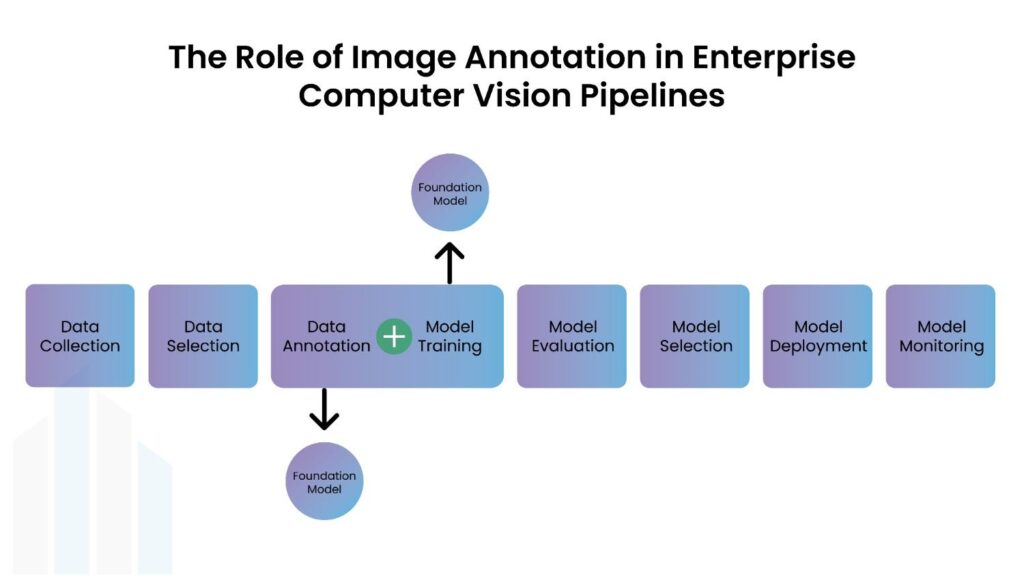
AI image annotation is not a preparatory task relegated to the margins of machine learning workflows. It is the structural layer on which computer vision models either generalize reliably or fail under real-world variance. As enterprises accelerate adoption of vision-based systems, the focus has moved decisively from whether annotation is required to how it is designed, governed, and scaled.
At enterprise maturity, annotation is no longer about volume alone. It is about precision, repeatability, and alignment with downstream business outcomes.
What is Image Annotation and How Does It Work?
Image annotation is the process of labeling visual data to make it understandable for AI and machine learning models. It involves adding metadata such as bounding boxes, segmentation masks, keypoints, or classification tags to images, enabling models to recognize objects, patterns, or actions with precision.
The process typically begins with raw image collection from cameras, sensors, or video feeds. Annotators then apply structured labels according to predefined guidelines, which may vary depending on the model’s objective such as autonomous navigation, medical imaging, retail analytics, or industrial inspection. Quality control mechanisms such as inter-annotator agreement, gold-standard datasets, and automated validation checks ensure that labels are consistent, accurate, and reproducible.
Image annotation works as the bridge between human understanding and machine perception. Without it, AI systems cannot reliably interpret the visual world, and model performance suffers, particularly in complex or high-stakes applications.
How AI in Image Annotation Service Defines Model Performance?
Model performance depends heavily on the quality of its training data; so, precision, contextual accuracy, and consistency now matter more than raw labeling volume. Datasets that are poorly annotated introduce hidden bias and compounding errors, which often only appear after deployment. In contrast, carefully curated datasets deliver value across different environments, geographies, and evolving use cases.
High-quality annotation captures subtle details and preserves ambiguity while clearly defining boundaries where certainty is required. This disciplined approach ensures that models can generalize effectively, adapting to real-world variability rather than overfitting to idealized conditions.
to deliver interpretation grounded in precision, accountability, and operational intent.
Decached Image Annotation Services for Autonomous Vehicles
Decached image annotation services demand a distinct level of operational rigor. Visual data from LiDAR-camera fusion, edge devices, and urban sensors carries temporal dependencies that cannot be flattened without loss. Bounding boxes, instance segmentation, and semantic layers must respect motion continuity, occlusion logic, and environmental variability.
Decached workflows, where raw data capture is logically separated from annotation pipelines, enable high-throughput processing without compromising sequence integrity. This structure allows annotators to work at scale while preserving the temporal context critical to autonomous decision-making.
Edge cases define system resilience. Rain-smeared lenses, low-angle glare, construction zones, and unmarked roads cannot be normalized away. Annotation strategies must retain these anomalies to reflect the world as it is. Adjacent industries, particularly insurance and risk modeling, increasingly adopt similar approaches as visual evidence becomes central to claims validation and fraud detection, a trajectory reflected in broader analyses of global insurance BPO evolution.
Image Annotation and the Architecture of Data Quality
Image annotation services are only as effective as the quality framework that underpins them. Data quality is not a single checkpoint but a layered system of controls. Clear yet adaptable annotation guidelines, inter-annotator agreement benchmarks, gold-standard datasets, and continuous feedback loops form the foundation of reliable labeling programs.
Advanced providers embed statistical sampling, confidence scoring, and error taxonomy into their pipelines. Quality assurance shifts from subjective review to measurable performance. In sectors where annotated images directly influence underwriting, diagnostics, or compliance outcomes, this rigor is non-negotiable. The convergence of annotation and analytics is transforming insurance workflows, where visual data plays a growing role in automation and risk assessment.
Image Annotation Service Models: In-House vs. Specialist Providers
Selecting an image annotation service model is a strategic decision rather than a procurement exercise. In-house teams offer proximity to domain expertize, but they often struggle with scalability, tooling upkeep, and annotation fatigue over time.
Specialist providers operate annotation as a core capability as they invest in platformed workflows, calibrated workforces, and process redundancy. The most effective engagements blend internal domain ownership with external operational maturity. Shared taxonomies, aligned validation metrics, and secure data environments allow organizations to retain intellectual control while benefiting from industrial-scale execution.
Image Annotation Outsourcing Service as a Scalability Lever
An image annotation outsourcing service becomes critical when data volumes fluctuate unpredictably. Product launches, regulatory shifts, or seasonal demand can multiply annotation requirements with little notice. Outsourcing introduces elasticity without sacrificing standards, provided governance frameworks are explicit.
Mature outsourcing models emphasize workforce specialization whereby annotators are trained on narrow task bands, reducing cognitive drift and improving label consistency. For organizations managing multi-country datasets, follow-the-sun operations sustain momentum across time zones while preserving review depth.
Image Annotation Outsourcing in Regulated Industries
Outsource image annotation is often scrutinized in regulated environments, yet it is precisely here that structured externalization offers the greatest control. Compliance depends on auditability, so each label must be traceable to defined guidelines, reviewers, and revision histories.
In insurance, healthcare, and financial services, annotated images increasingly inform automated decisions. Outsourcing frameworks that integrate data residency controls, access logging, anonymization protocols, and documented QA processes allow organizations to scale annotation while remaining aligned with regulatory expectations.
Outsource Image Annotation for Accuracy, Velocity, and Cost Control
Image annotation outsourcing is not about relinquishing quality but about operationalizing it at scale. Accuracy improves when annotation is managed as a production system rather than an ad hoc task. Velocity increases through parallelized workflows, coordinated orchestration, and purpose-built tooling, while cost control emerges from predictable throughput and reduced rework.
Enterprises that succeed with outsourced annotation focus on defined outcomes rather than raw volumes. They set clear variance thresholds, establish escalation paths, and measure performance through continuous improvement benchmarks. Providers with deep cross-industry experience, such as IMS Datawise, treat annotation as a governed data function, aligning people, process, and technology to support sustained model performance rather than short-term throughput alone.
Over time, this disciplined approach transforms annotation from an operational bottleneck into a competitive enabler, accelerating deployment cycles while maintaining control over quality and risk.
Conclusion
AI image annotation sits at the intersection of data engineering and enterprise strategy. Its impact extends beyond model training to influence decision accuracy, regulatory confidence, and customer trust. As use cases expand across autonomous systems, insurance, retail, healthcare, and surveillance, the demand for disciplined annotation will only intensify.
Organizations that invest in robust annotation frameworks, whether developed internally or supported by experienced partners like IMS Datawise, transform visual data into durable operational intelligence. In doing so, we ensure their AI systems move beyond basic visual recognition to deliver interpretation grounded in precision, accountability, and operational intent.