

The success of computer vision no longer depends on how much data is collected, but on how deliberately that data is prepared. As 2026 approaches, organizations are reassessing how visual datasets are structured, reviewed, and governed, because weak annotation now represents one of the most common points of failure in production AI systems.
As vision models are deployed across regulated, revenue-bearing environments, annotation practices are being redesigned to deliver consistency, traceability, and operational continuity. This article examines the forces reshaping annotation in 2026 and explains why these shifts are critical to building enterprise-grade AI systems that perform reliably beyond the lab.
Image and Data Annotation as an Enterprise Capability
Image-based labeling is increasingly embedded into enterprise data strategy rather than treated as a preliminary task in model development. Organizations now align visual labeling programs with model objectives from the outset, ensuring that training datasets reflect real operational conditions rather than curated or idealized environments.
This shift is especially evident in industries such as insurance, where images inform claims validation, damage assessment, and fraud analysis. As reflected in broader insurance BPO trends, maturity in managing visual datasets directly influences how confidently computer vision systems can be operationalized across high-impact, business-critical workflows.
AI-Powered Image Annotation and Controlled Acceleration
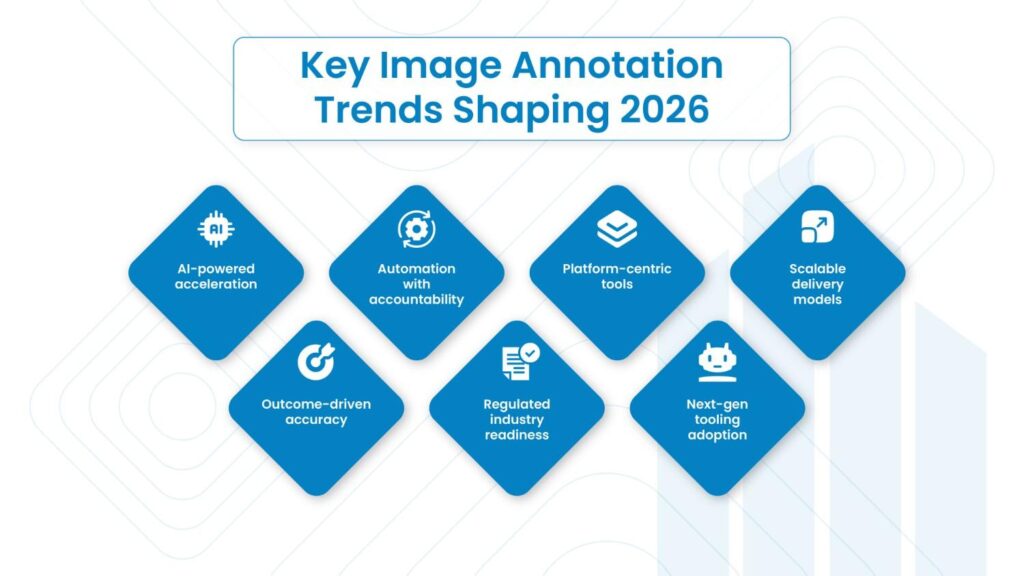
Image annotation tools have matured beyond basic pre-labeling. In 2026, their primary role is controlled acceleration rather than full autonomy. Models generate initial labels, while human reviewers apply contextual judgment, resolve ambiguity, and validate edge conditions.
This balance ensures speed without sacrificing interpretive depth. Enterprises are prioritizing predictability and traceability over unchecked automation, especially where annotation outcomes influence downstream decisions. For a deeper dive into how quality in AI image annotation impacts overall data performance, explore this comprehensive guide.
Annotation Automation Trend Analysis
Automated image annotation is increasingly governed by accountability frameworks. Automation pipelines now include confidence thresholds, escalation rules, and revision traceability as standard design elements.
These trends reflect a broader realization that automation must remain inspectable. Labels are treated as evolving data assets, continuously refined as models learn and environments change.
Image Annotation Tools 2026: Platform-Centric Evolution
Image annotation workflow is no longer a point solution; rather, it is a platform-centric system that integrates workflow orchestration, quality analytics, and domain-aware taxonomies.
Advanced tooling now supports adaptive sampling, annotator performance insights, and dataset version control. Similar platformization is reshaping insurance-focused AI initiatives, where annotation systems are tailored to claims imagery, damage assessment, and document-image fusion, as explored in analyses of how data annotation is transforming insurance operations.
Image Annotation Design for Operational Resilience
A modern image annotation setup is modular, risk-aware, and execution-driven. Tasks are segmented by complexity and routed according to reviewer expertise, allowing high-volume labeling to proceed without overwhelming specialist reviewers. Workflow intelligence replaces manual coordination as this structure improves consistency, reduces rework, and enables rapid scaling without compromising review rigor.
Scalable Image Annotation for Enterprise AI Programs
The scalability of image annotation processes in 2026 is defined by stability under pressure. Enterprises focus on sustaining accuracy and consistency as data volumes fluctuate due to seasonal demand, regulatory shifts, or product expansion.
Scalability is achieved through standardized schemas, distributed delivery models, and continuous calibration. When designed correctly, scale reinforces quality rather than eroding it.
Image Annotation Accuracy as a Performance Indicator
The accuracy of image annotation is increasingly evaluated through its impact on model behavior. Rather than relying solely on agreement scores, organizations assess how annotation quality influences bias, generalization, and operational error rates.
This outcome-driven approach encourages labeling strategies that capture uncertainty where it exists and precision where it matters most, producing training data aligned with real-world variance.
AI Training Data Annotation in Regulated Environments
AI data annotation faces heightened scrutiny in regulated sectors such as insurance, healthcare, and financial services. Auditability, data lineage, and reviewer accountability are now baseline expectations.
Annotation programs incorporate documented guidelines, controlled access environments, and repeatable QA protocols. Providers with deep domain exposure, such as IMS Datawise, support these requirements by combining operational scale with governance-led execution, enabling organizations to expand annotation programs without diluting compliance standards.
Image Annotation Challenges and Next-Gen Image Annotation Tools
Persistent operational constraints, including annotator fatigue, dataset bias, and contextual ambiguity, are accelerating the shift toward more advanced tooling. As visual datasets grow in scale and complexity, traditional interfaces and linear review models struggle to maintain consistency, leading to quality drift and delayed feedback cycles.
Next-generation platforms are designed to address these limitations at a structural level. Intelligent task routing assigns work based on annotator expertise, historical performance, and task complexity, reducing cognitive overload while improving label consistency. Adaptive sampling mechanisms surface edge cases earlier in the process, ensuring that rare or high-risk scenarios receive focused attention rather than being diluted within high-volume workloads.
Explainability has also become a core design principle with modern systems exposing the labeling rationale through embedded context, reference examples, and decision metadata, making labels interpretable and reviewable across teams. This transparency supports stronger governance and simplifies downstream audits, particularly in regulated environments.
Teams with deep operational experience, including those at IMS Datawise, increasingly adopt these platforms as part of a broader shift toward treating visual labeling as an integrated data function. By combining advanced tooling with structured processes, organizations can systematically address complexity, reduce rework, and sustain quality as annotation programs evolve.
The Road Ahead for Image Data Annotation
By 2026, Image Data Annotation has become a defining factor in AI reliability and enterprise readiness. Organizations that invest in structured frameworks, platform-driven tooling, and execution-focused workflows are better positioned to deploy vision systems with confidence. Industry practitioners with deep domain exposure, such as IMS Datawise, offer customized industry solutions that emphasize disciplined execution models that balance scale, governance, and contextual accuracy.
The advantage no longer lies in labeling faster, but in labeling with intent, consistency, and foresight. As AI systems assume greater decision-making responsibility, the rigor applied to visual data will continue to shape how effectively machines interpret, and act upon, the visual world.